
🕉️
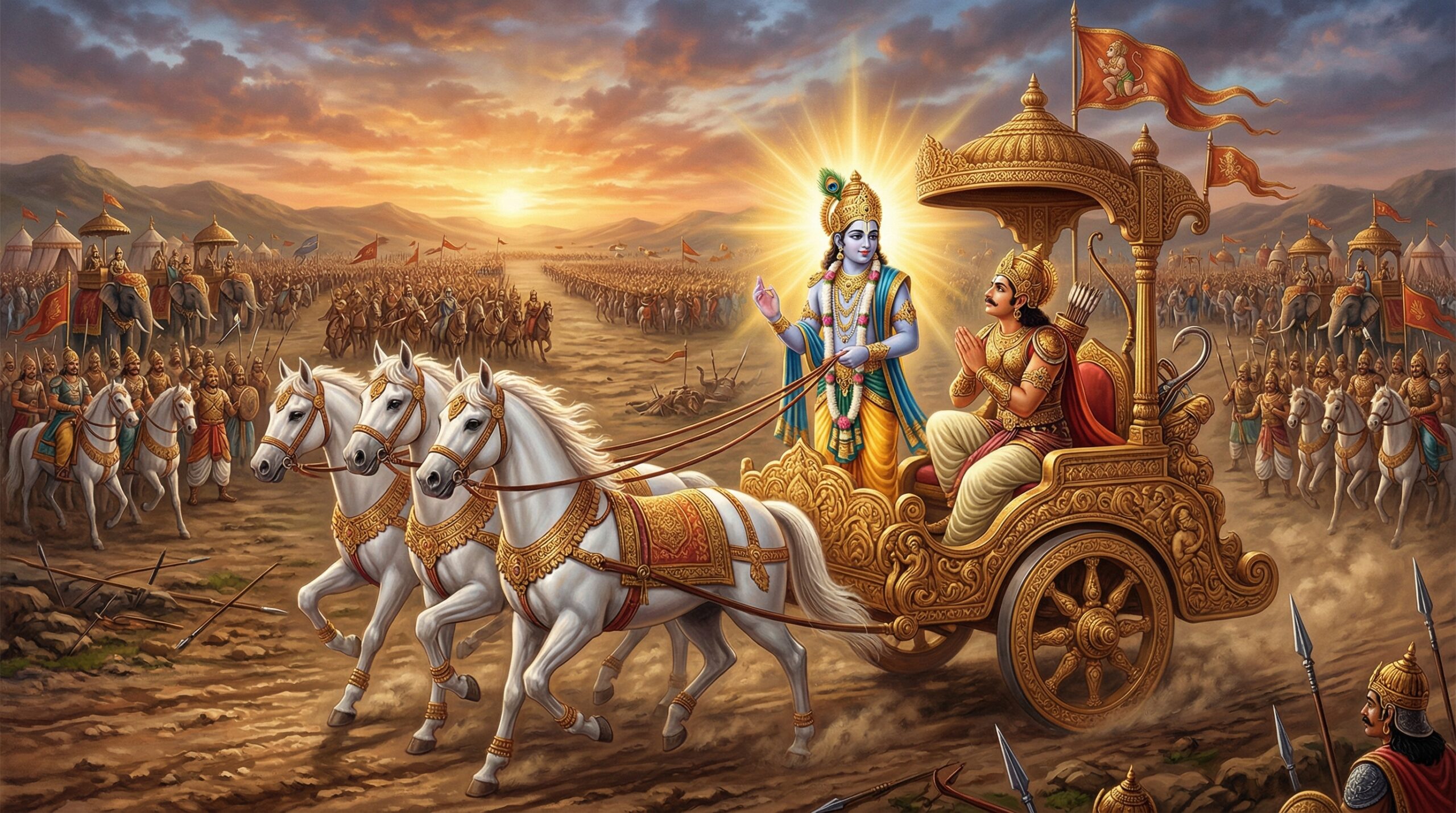
Kurukshetra is one of the most sacred places in Hindu tradition. It is the legendary battlefield of the Kurukshetra War and the place where Lord Krishna revealed the divine wisdom of the Bhagavad Gita to the warrior prince Arjuna. For thousands of years, this sacred land has symbolized dharma, spiritual awakening, and the eternal teachings of righteousness.
The Land That Heaven Chose
Kurukshetra: The Eternal Land of the Bhagavad Gita is a sacred pilgrimage site in Haryana, India, revered as Dharmakshetra (the field of righteousness) in the Mahabharata. This ancient land, also known as the “Land of the Bhagavad Gita,” is where Lord Krishna delivered his timeless discourse on duty, karma, and devotion to a despondent Arjuna on the battlefield. The teachings of the Bhagavad Gita continue to guide millions worldwide, making Kurukshetra a profound symbol of spiritual wisdom amid conflict.
“One who dies in Kurukshetra, even by the sting of a mosquito, attains the highest heaven — for this land is ever consecrated by Brahma himself.”
— Vamana Purana
The Sacred Land of Dharma
Kurukshetra is often referred to as Dharmakshetra, meaning “The Field of Righteousness.” According to the ancient epic Mahabharata, this land became the stage for one of the greatest battles in history — the Kurukshetra War.
The war was fought between the Pandavas and the Kauravas, representing the eternal struggle between dharma (righteousness) and adharma (injustice). Because this battle was fought for justice and moral duty, Kurukshetra became a spiritually powerful land in Hindu belief.
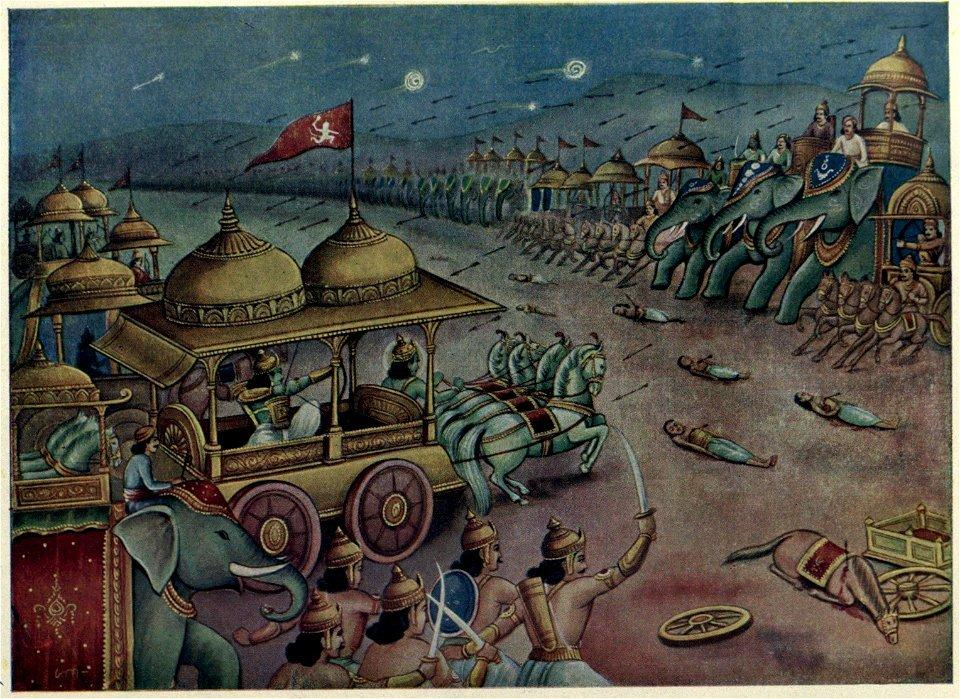
The epic’s central event—the great Kurukshetra War (also called the Mahabharata War)—unfolded here between the Pandavas (five brothers: Yudhishthira, Bhima, Arjuna, Nakula, and Sahadeva) and their cousins, the Kauravas (led by Duryodhana). The 18-day war arose from a dynastic dispute over the throne of Hastinapura and marked the transition to the Kali Yuga. Millions of warriors perished, but the war’s true essence lies in the moral and philosophical dilemmas it raised
The Bhagavad Gita: Divine Wisdom on the Battlefield
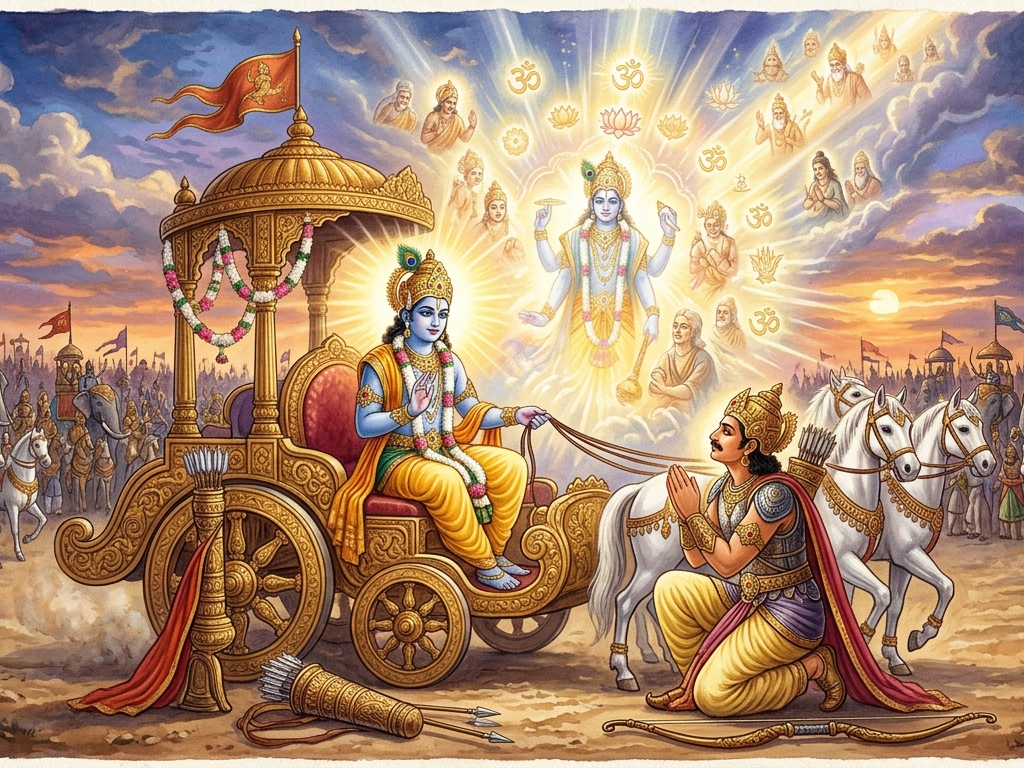
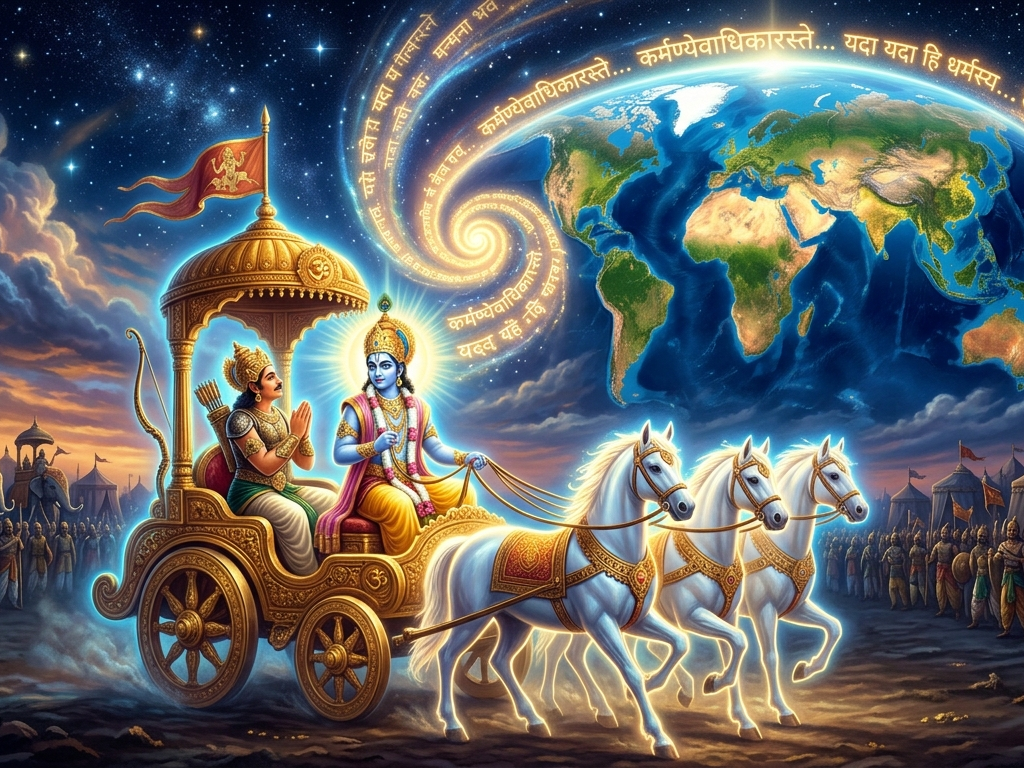
On the eve of the war, Arjuna, the greatest archer, hesitated to fight his relatives, teachers, and friends. Overwhelmed by grief and moral confusion, he laid down his weapons. Lord Krishna, serving as his charioteer, delivered the Bhagavad Gita—a 700-verse dialogue that forms chapters 23-40 of the Bhishma Parva in the Mahabharata.
“Karma Nye vadhikaraste
Ma phaleshu kadachana,
Ma karma-phala-hetur bhur
Ma te sango’stv akarmani.”
You have a right to perform your prescribed duties, but you are not entitled to the fruits of your actions. Never consider yourself the cause of the results, and never be attached to inaction.
— Bhagavad Gita, Chapter II, Verse 47
The Gita covers the full spectrum of spiritual philosophy — from Karma Yoga (the path of action) and Jnana Yoga (the path of knowledge) to Bhakti Yoga (the path of devotion) and Raja Yoga (the path of meditation). It addresses the nature of the self, the imperishable soul, the reality of time and death, the structure of creation, and the ultimate path to liberation. Kurukshetra became the classroom; Arjuna, the student; and Krishna, the eternal teacher.
At that moment, Lord Krishna, serving as Arjuna’s charioteer, delivered the divine teachings of the Bhagavad Gita.
These teachings explained important spiritual truths, including:
✨ The meaning of life and duty
✨ The path of devotion and knowledge
✨ The importance of selfless action
✨ The eternal nature of the soul
This discourse transformed Arjuna’s despair into resolve, leading him to fight.
The Kurukshetra War — Eighteen Days That Reshaped the World
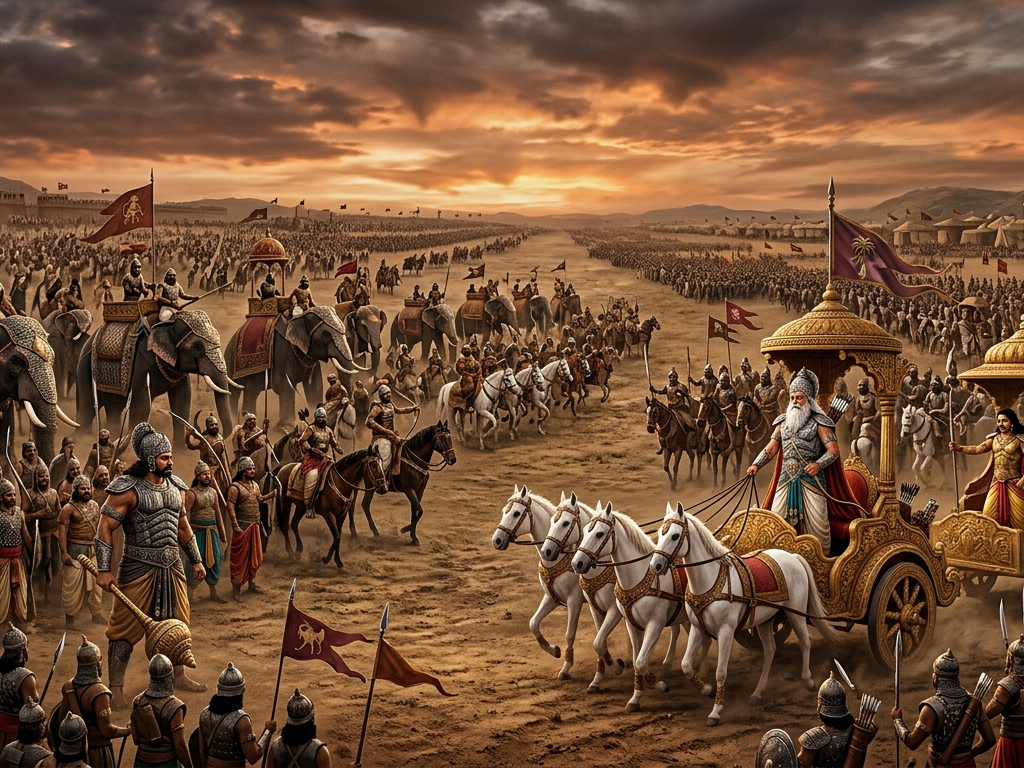
The war of Kurukshetra, also known as the Dharma Yuddha (the Righteous War), was fought between the Pandavas brothers and their cousins the Kauravas. It was not merely a family feud amplified to epic proportions — it was a cosmic drama, the culmination of an age, the end of the Dvapara Yuga and the threshold of the Kali Yuga. The forces arrayed were staggering: eleven Akshauhinis on the Kauravas side and seven on the Pandavas side — millions of warriors, horses, elephants, and chariots.
Day 1 — The Conches Sound
Bhishma Pitamaha is appointed commander-in-chief of the Kaurava forces. The Pandavas are led by Dhrishtadyumna. The war begins with a thunderous blowing of conches — the most famous of which is Krishna’s Panchajanya.
Days 1–10 — The Fall of Bhishma
The grandsire Bhishma holds the field for ten days, seemingly invincible. On the tenth day, Shikhandi advances and Arjuna’s arrows bring Bhishma down — to rest on a bed of arrows, choosing the moment of his own death.
Days 11–15 — Drona’s Command
Dronacharya, the guru, leads the Kauravas. The great formation of the Chakravyuha is used. Abhimanyu, the young hero, enters but cannot exit — and falls, surrounded, in one of the most heartbreaking moments of the epic.
Day 16–17 — Karna’s Fateful Stand
Karna, the tragic hero, commands the Kaurava forces. His chariot wheel sinks into the earth. Arjuna, directed by Krishna, fires the fatal arrow. The sun seems to weep.
Day 18 — The Last Dawn
The war ends. Duryodhana, the last standing Kaurava warrior, falls to Bhima’s mace. Kurukshetra falls silent. The Pandavas stand victorious — but hollow, surrounded by loss beyond measure.
The battle ultimately ended with the victory of the Pandavas, symbolizing the triumph of justice and righteousness.
When the dust settled after eighteen days, the field was littered with the warriors of both sides — fathers, sons, teachers, and students. The Mahabharata records that virtually every major hero perished. Yet dharma had prevailed. The Pandavas, led by Yudhishthira, ascended the throne of Hastinapura — a victory that felt, to those who had lived through it, more like a wound than a triumph.
Sacred Sites — Where the Divine Still Lingers
Today, Kurukshetra is a living pilgrimage town. Walking its lanes, visiting its temples, and standing at its sacred ponds, one senses a continuity of spirit — as though the prayers of five thousand years have soaked into the stones themselves. Here are the most important sacred sites in Kurukshetra:
Brahma Sarovar
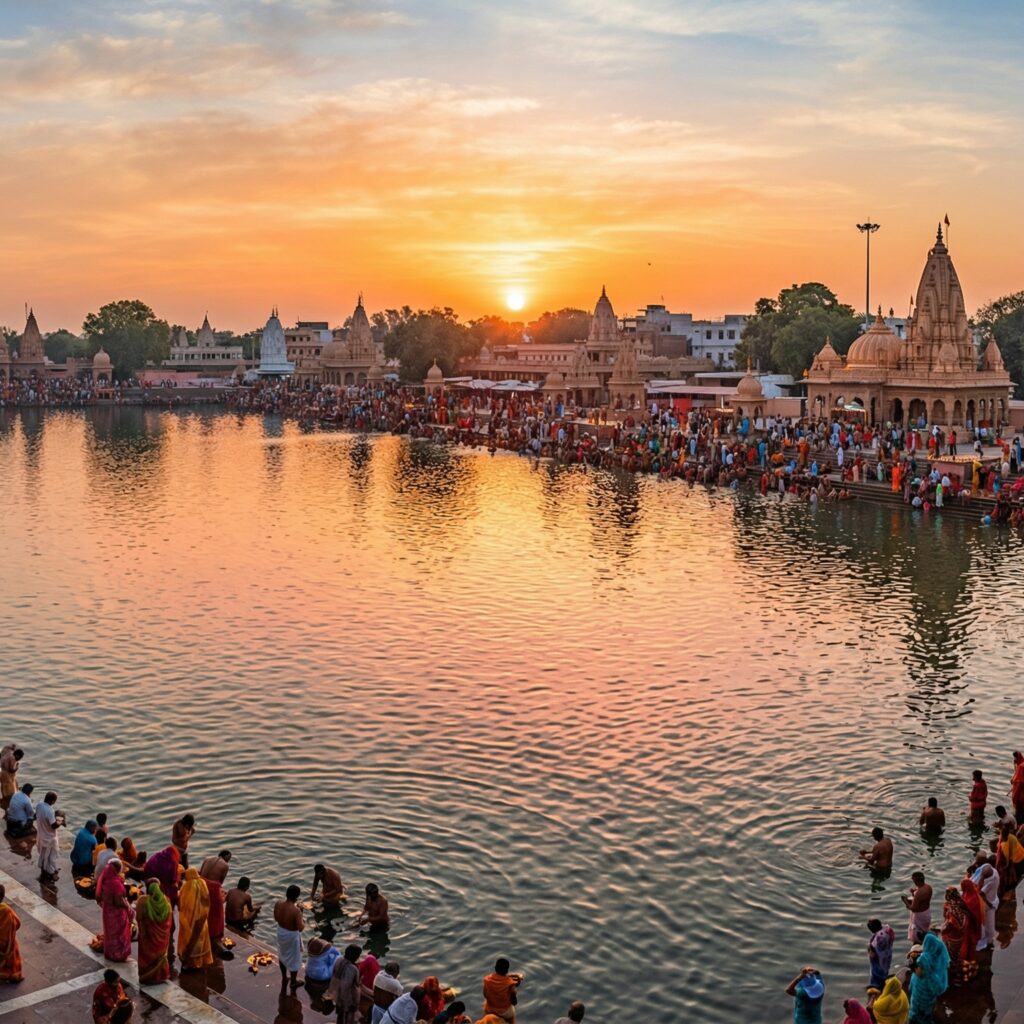
Brahma Sarovar is one of the most famous pilgrimage spots in the city. According to legend, this is the place where Lord Brahma performed the act of creation.
The largest sacred tank in Kurukshetra, where Brahma is said to have performed the first cosmic sacrifice. A solar eclipse bath here is believed to grant the merit of a thousand Ashwamedha yajnas.
Many devotees believe that bathing in this sacred water cleanses sins and brings spiritual blessings.
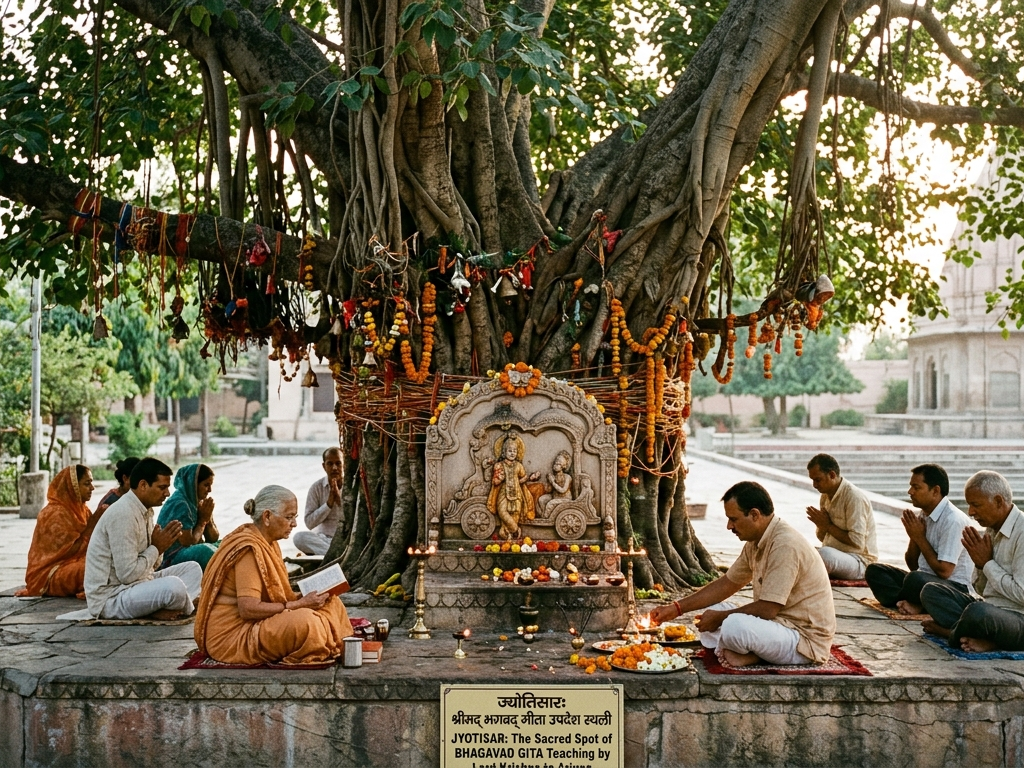
Jyotisar – The Birthplace of the Gita
The exact spot where Lord Krishna delivered the Bhagavad Gita to Arjuna. An ancient banyan tree here is believed to be the same tree that witnessed the divine discourse. A marble chariot marks the sacred ground.
Pilgrims from across the world visit Jyotisar to experience the spiritual energy of this holy place.
Sannihit Sarovar
A sacred reservoir where all the holy rivers of India are believed to assemble on the day of Amavasya (new moon). Bathing here during a solar eclipse is considered supremely auspicious.
Beyond these, Kurukshetra houses over 360 sacred tirthas — each associated with a chapter of the Mahabharata or a specific deity. The Sthaneshwar Mahadev Temple, dedicated to Lord Shiva, is where the Pandavas prayed before battle. The Bhadrakali Temple honours the goddess who bore witness to the war. The Panorama and Science Centre of Kurukshetra recreates the battle scenes in vivid detail for modern visitors.
Why Kurukshetra Remains Eternal
Kurukshetra is not just a historical battlefield but a living metaphor for the internal war between dharma and adharma that every individual faces. The Bhagavad Gita’s message—”Perform your duty without attachment to results”—transcends time, inspiring leaders, philosophers, and seekers globally.
Visiting Kurukshetra offers a transformative experience: walk the same grounds where gods and heroes clashed, meditate at Jyotisar, and feel the divine presence that turned a war into a source of eternal wisdom.
“The Bhagavad Gita has a kinship with the soul of India. The wonder of it is that it still speaks to us — not from the past, but from a timeless present.”
— Rabindranath Tagore
The Eternal Message of the Bhagavad Gita
The teachings of the Bhagavad Gita revealed in Kurukshetra are timeless and universal.
Its message teaches humanity to:
🌿 Perform duties with sincerity
🌿 Remain detached from material results
🌿 Follow the path of righteousness
🌿 Develop devotion and self-realization
These teachings continue to guide millions of people around the world.
Kurukshetra endures not because of the war fought there, but because of the word spoken there. It is the land where the Absolute chose to speak in a human voice — and that voice, once heard, never truly falls silent.
“Yada yada hi dharmasya
glanir bhavati Bharata,
abhyutthanam adharmasya
tadatmanam srjamy aham.”
— Bhagavad Gita, Chapter IV, Verse 7
Conclusion
Kurukshetra is more than just a historical battlefield. It is a sacred land where divine wisdom was revealed and where the eternal teachings of the Bhagavad Gita were born.
For devotees, historians, and spiritual seekers, Kurukshetra stands as a powerful reminder that dharma always triumphs over adharma.
The land of Kurukshetra will forever remain the eternal home of the Bhagavad Gita’s wisdom. ✨