
🕉️
The Bhagavad Gita is a timeless spiritual guide that offers wisdom about duty, purpose, and inner peace. Though spoken thousands of years ago on the battlefield of Kurukshetra, its teachings continue to help people face modern struggles such as stress, confusion, and moral dilemmas.
Introduction
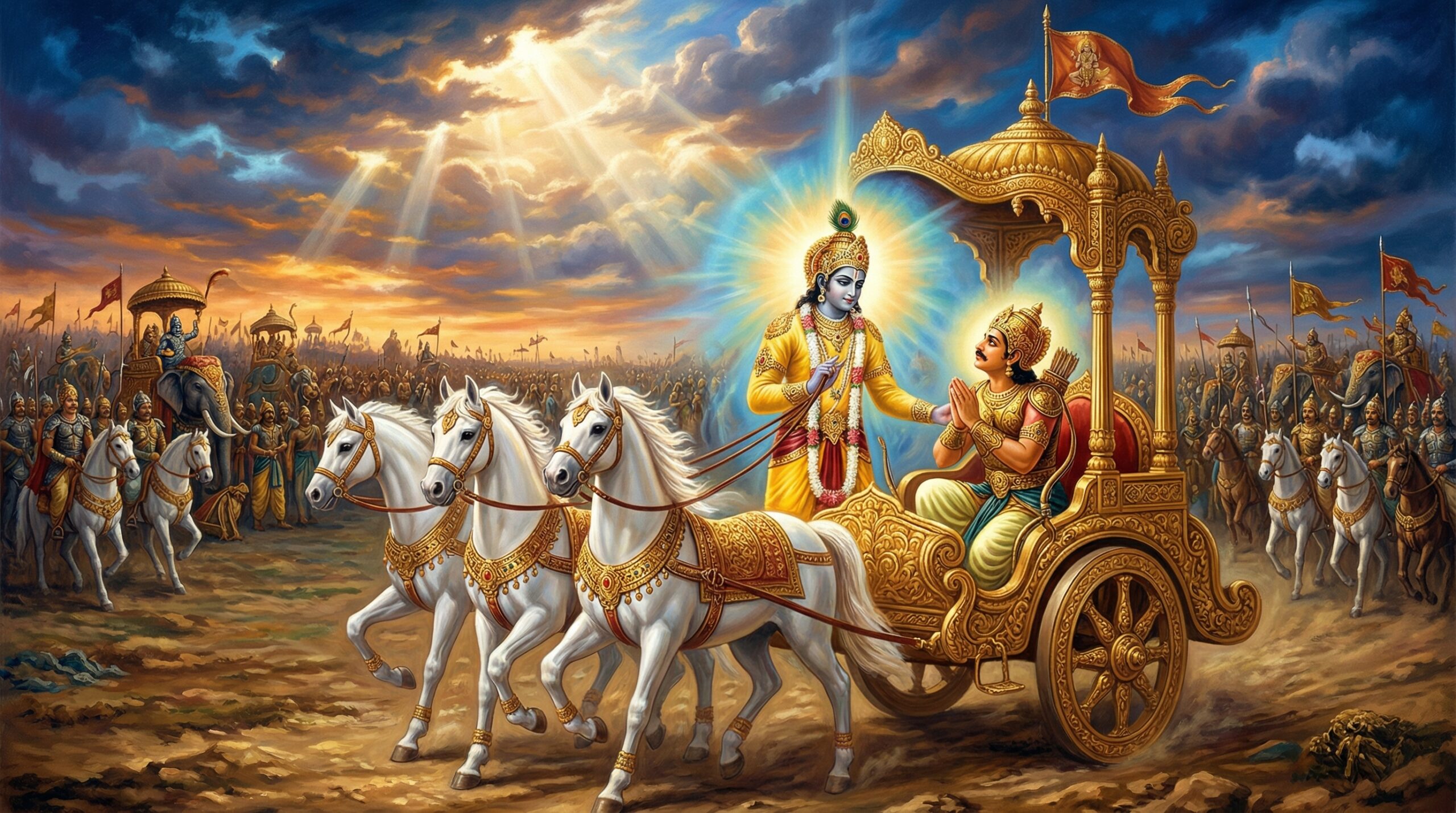
More than five thousand years ago, on the sacred battlefield of Kurukshetra, a profound conversation took place between Krishna and the warrior prince Arjuna. This conversation became the Bhagavad Gita, one of the most influential spiritual texts in the world.
Although the setting was a battlefield, the teachings of the Bhagavad Gita go far beyond war. They explore the deepest questions of human life—purpose, duty, morality, and spiritual awakening. Even today, in a fast-moving modern world filled with uncertainty, its wisdom continues to guide millions.
| Composed Between 400 BCE – 200 CE |
| Language Classical Sanskrit |
| Setting Battlefield of Kurukshetra |
| Speakers Krishna & Arjuna |
A Guide for Life’s Difficult Decisions
One of the main reasons the Bhagavad Gita remains relevant is its guidance during difficult moments.
At the start of the dialogue, Arjuna is confused and emotionally overwhelmed. He does not want to fight against his own relatives and teachers. In response, Krishna explains the importance of Dharma (duty) and encourages Arjuna to act with righteousness and clarity.
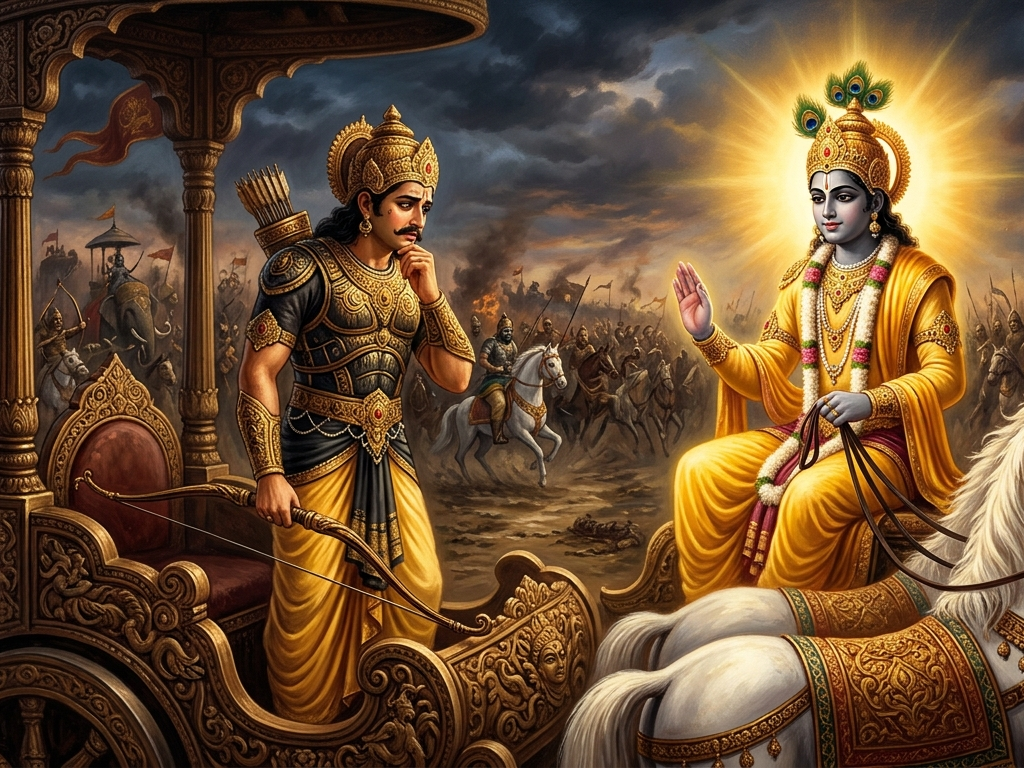
In modern life, people face similar dilemmas—choosing between career and family, dealing with ethical challenges, or making life-changing decisions. The Gita teaches that one must act with wisdom, courage, and responsibility.
“Let right deeds be thy motive, not the fruit which comes from them.”
— Bhagavad Gita, Chapter 2, Verse 47
Three paths to liberation
The Gita is notable for its pluralism. Krishna does not prescribe a single path to wisdom and liberation. Instead, he outlines three primary paths, acknowledging that different personalities and temperaments call for different approaches:
| Jnana Yog The path of knowledge and discriminative inquiry into the nature of reality |
| Bhakti Yoga The path of devotion, love, and surrender to the divine |
| Karma Yoga The path of selfless action, duty performed without craving reward |
The Search for Purpose
Many people today struggle with a fundamental question: “What is the purpose of my life?”
The Bhagavad Gita answers this by explaining that life is not just about material success. Instead, it is about spiritual growth and understanding our connection with the divine.
Krishna teaches different spiritual paths:
- Karma Yoga – selfless action
- Bhakti Yoga – devotion to God
- Jnana Yoga – the path of knowledge
Each person can choose a path according to their nature.
One of the most famous teachings in the Bhagavad Gita is Karma Yoga, the path of selfless action.
Krishna teaches Arjuna:
Perform your duty without attachment to the results.
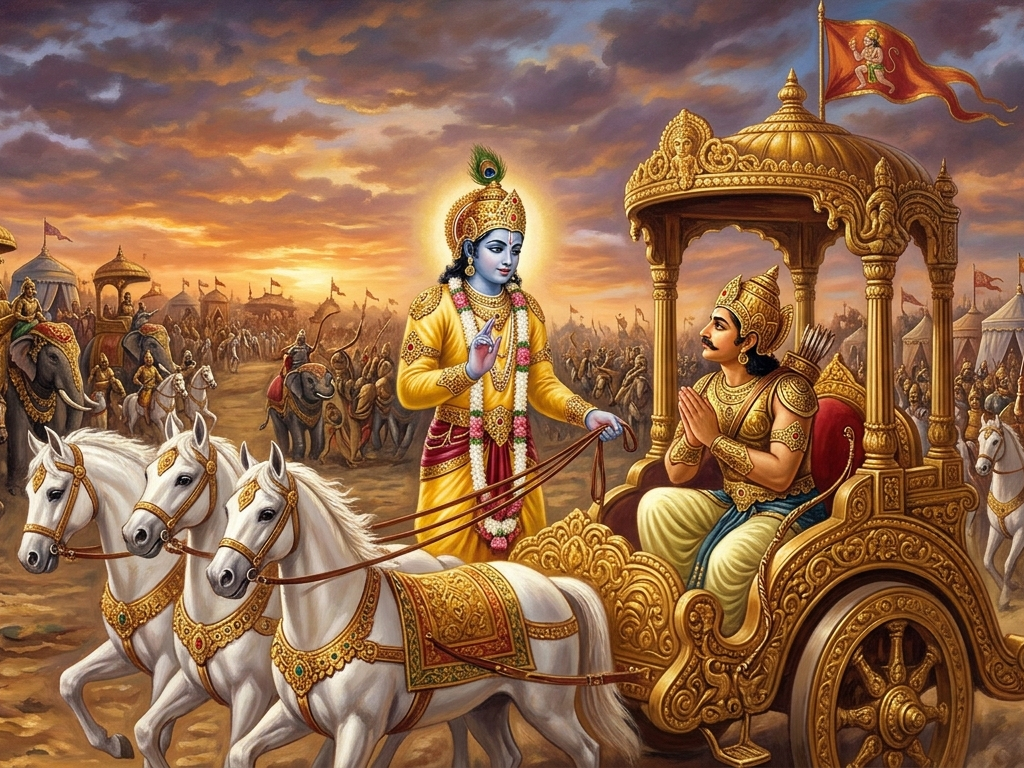
This idea is extremely powerful in today’s competitive world. Many people feel stressed because they constantly worry about success, failure, or recognition. The Gita advises focusing on effort rather than outcome.
By doing our work sincerely and letting go of anxiety about results, we can live a more peaceful and balanced life.
On the self — the eternal and the temporary
The second chapter of the Gita contains one of world philosophy’s most bold and sustained meditations on the nature of the self. Krishna tells Arjuna that the true self — the Atman — is not the body, which is mortal and changing, but an eternal, unchanging awareness. “Weapons cannot cut it, fire cannot burn it, water cannot wet it, wind cannot dry it.”
This view has resonated across cultures and centuries, finding echoes in Stoic philosophy, Buddhist perspectives on impermanence, and modern existential thought. While the metaphysical framework may differ across traditions, the practical implication is consistent: identifying too strongly with fleeting identities — job titles, social roles, physical appearance — is a source of suffering.
“The soul is never born nor dies at any time. It has not come into being, does not come into being, and will not come into being.”
— Bhagavad Gita, Chapter 2, Verse 20
Mental health and equanimity
The Sanskrit concept of Sthitaprajna — one who is stable in wisdom, undisturbed by sorrow, free from desire, neither rejoicing in good fortune nor disturbed by bad — maps remarkably well onto what positive psychologists describe as emotional regulation and resilience. The Gita does not promise a life without hardship; it offers a philosophy for moving through hardship without being destroyed by it.
For the millions around the world grappling with anxiety, grief, and uncertainty, the Gita’s teachings on equanimity are not abstract theology. They are practical guidance. Accept what you cannot change. Act on what you can. Release attachment to outcomes. These maxims, in various forms, underlie every major therapeutic tradition from Stoicism to cognitive behavioural therapy.
Mastering the Mind
Modern society faces growing problems such as stress, anxiety, and overthinking. Surprisingly, the Bhagavad Gita addressed these issues thousands of years ago.
Krishna explains that the mind can either be a person’s best friend or their worst enemy. Through discipline, meditation, and self-control, a person can achieve inner stability.
These teachings closely resemble modern practices such as mindfulness and meditation that people use today for mental health.
Relevance to modern leadership and management
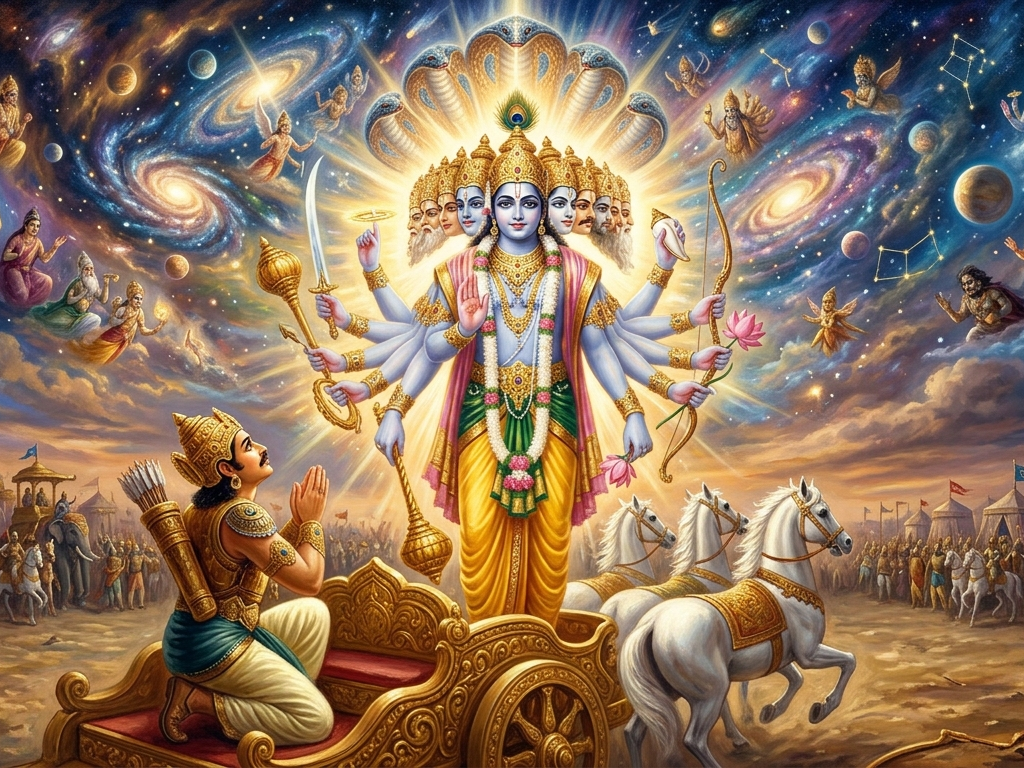
Business schools and leadership programmes around the world have begun drawing on the Gita’s framework. Krishna’s role as a counsellor to Arjuna represents a model of servant leadership — guiding rather than commanding, empowering rather than directing. He does not fight Arjuna’s battle for him. He helps Arjuna rediscover his own strength.
The concept of Svadharma — one’s own duty and path, as distinct from another’s — is a powerful reframe for the modern professional. Rather than benchmarking oneself against others, the Gita counsels alignment with one’s own nature, skills, and calling. “Better is one’s own dharma, even if imperfectly performed, than the dharma of another well performed.”
Influence across the world
The Gita’s reach has extended far beyond the Indian subcontinent. Mahatma Gandhi called it his “spiritual dictionary” and drew on it daily during India’s independence movement. Henry David Thoreau carried it to Walden Pond. Albert Einstein regarded it as among the most important texts ever written. J. Robert Oppenheimer, upon witnessing the first nuclear detonation, recalled its verse: “Now I am become Death, the destroyer of worlds.”
These are not incidental connections. The Gita addresses questions so foundational — about duty, death, identity, action, and meaning — that thinkers from every tradition and century have returned to it.
A Universal Message
Although the Bhagavad Gita originated within the epic Mahabharata, its message is universal.
People from different cultures, religions, and philosophies have admired its wisdom. Leaders, scholars, and spiritual teachers around the world have studied the Gita to understand its timeless guidance.
Its teachings about duty, discipline, compassion, and self-realization apply to all of humanity.
Final reflection
The Bhagavad Gita endures because it addresses the human condition at its most honest and most vulnerable. It does not offer comfort through denial or escape through fantasy. It places a person exactly where they are — in the middle of a battlefield, full of doubt — and says: even here, even now, there is a path through. The wisdom it offers is not dated. It was never bound by time. A scripture that begins with a person who cannot act, and ends with that same person finding the clarity to act rightly, is a scripture for every age — including ours.
Conclusion
The Bhagavad Gita is far more than an ancient scripture. It is a practical guide for living a meaningful life.
In a world filled with distractions and uncertainty, the dialogue between Krishna and Arjuna reminds us to act with courage, remain balanced in success and failure, and seek a deeper understanding of our true self.
That is why, even after thousands of years, the wisdom of the Bhagavad Gita continues to inspire and guide humanity