
🕉️
The story of Prahlada is one of the most powerful examples of faith in Hindu scriptures. Despite facing cruelty from his own father, the demon king Hiranyakashipu, Prahlada never stopped believing in Lord Vishnu. His unwavering devotion ultimately led to the divine appearance of Narasimha, proving that true faith always triumphs over arrogance and evil.
Prahlada: The Child Devotee Who Conquered Fear Through Faith
The Demon King Who Conquered the Heavens
To understand Prahlada, one must first understand his father — Hiranyakashipu, whose name translates to “He who cherishes gold and silken beds.” He was the elder of the two demon brothers Hiranyakashipu and Hiranyaksha, both sons of the sage Kashyapa and the demoness Diti.
After his brother Hiranyaksha was slain by Vishnu in the form of a great boar (the Varaha Avatar), Hiranyakashipu burned with rage and hatred toward the preserver of the universe. He undertook the most extreme penance imaginable — standing on one toe with his arms raised, eyes fixed on the sun, for thousands of years — to win an unassailable boon from Brahma the Creator.
The Five-Fold Boon of Hiranyakashipu
- He could not be killed by man or beast
- He could not be killed by any weapon forged by gods
- He could not be killed indoors or outdoors
- He could not be killed during day or night
- He could not be killed on earth, in water, or in the air
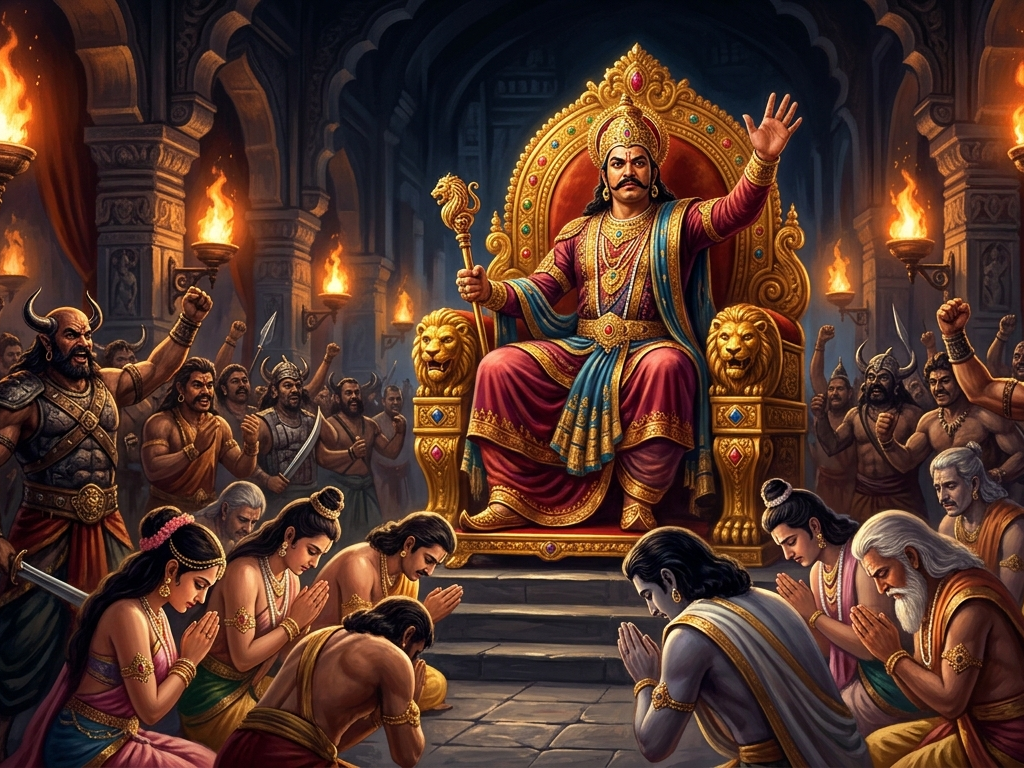
Armed with this near-perfect shield of invincibility, Hiranyakashipu conquered the three worlds — heaven, earth, and the underworld. He banned the worship of Vishnu across creation and declared himself the supreme god. The celestial beings trembled, sacrificial fires were extinguished, and the universe groaned under his tyranny. Yet the most dangerous rebellion against him would not come from gods or warriors — but from his own son.
The Birth of a Divine Devotee
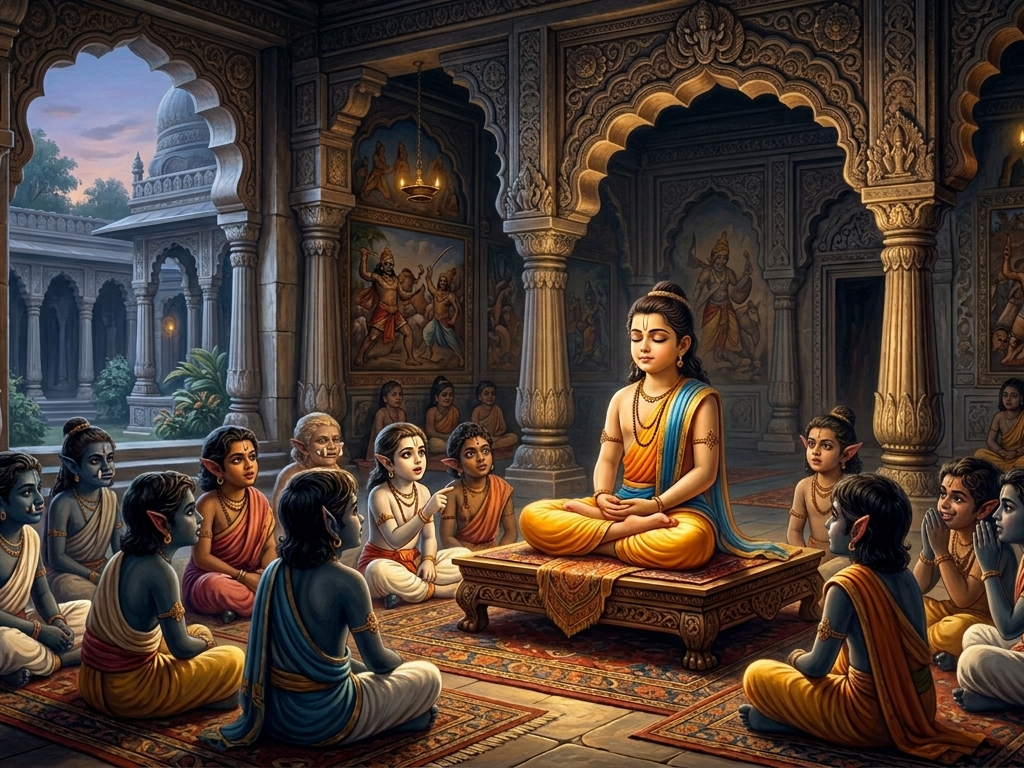
While Hiranyakashipu performed his great penance, the sage Narada Muni visited his pregnant wife Kayadu and spoke to her of Vishnu’s glories for weeks. The unborn child listened from the womb, absorbing every word — and was already a Vaishnava, a devotee of Vishnu, before he drew his first breath.
From the moment, Prahlada was born as the son of the powerful demon king Hiranyakashipu. His father ruled the three worlds and demanded that everyone worship him as the supreme lord.
However, from a very young age, Prahlada developed deep devotion to Vishnu, even while studying in the demon king’s palace, he constantly chanted Vishnu’s names and spoke about divine love and righteousness. His teachers at the royal gurukul tried to fill his mind with demonic politics and power, but in every lesson, Prahlada found only Vishnu. He would teach his classmates — the children of other demons — that the highest purpose of life was devotion to the Lord, not conquest or material desire.
✦ ✦ ✦
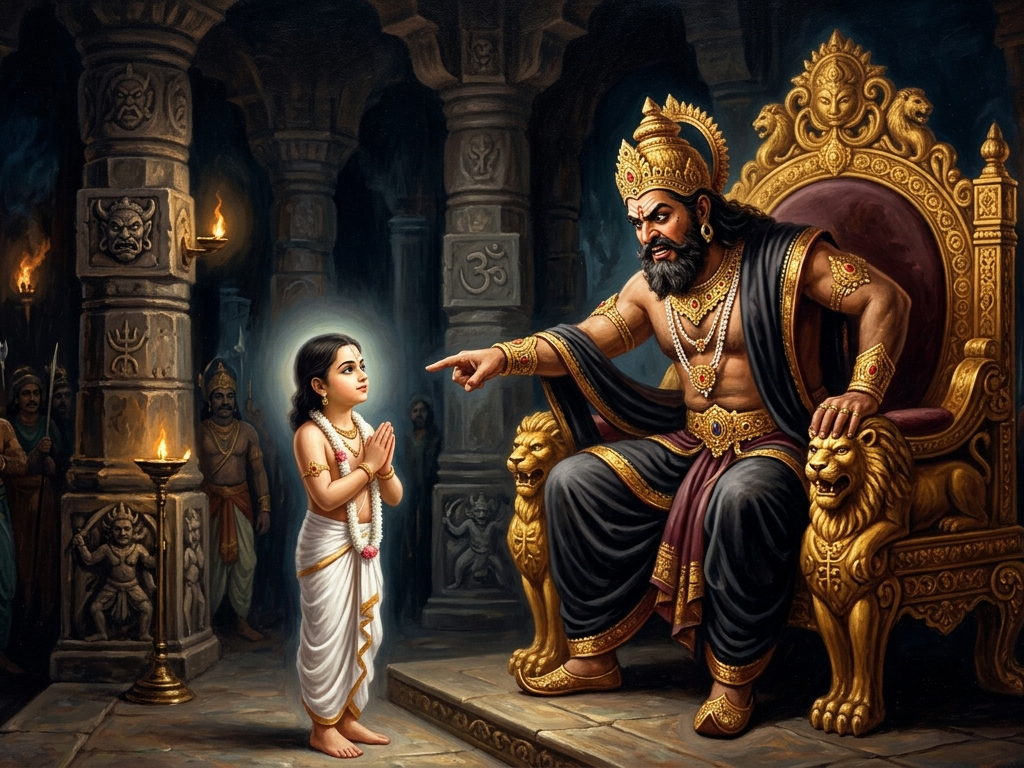
When word reached Hiranyakashipu that his beloved son was worshipping the Lord Vishnu he most hated, the demon king was enraged and disbelieving. He summoned Prahlada and asked what the greatest thing he had learned was. With serene eyes, the child replied: “Father, the greatest thing I have learned is devotion to Lord Vishnu.”
He declared himself greater than the gods and banned the worship of Vishnu. But Prahlada refused to obey.
When asked who the greatest power in the universe was, Prahlada boldly replied:
“The Supreme Lord Vishnu is everywhere.”
This enraged the demon king.
What followed was a sustained campaign of cruelty that would break the heart of any ordinary parent — except that Hiranyakashipu was no ordinary parent, and Prahlada was no ordinary child.
“My Lord is in the water, in the fire, in the air, and in every atom of this universe. He is not far — He is here, always.”
— Prahlada’s declaration to his father
Trials by Fire, Venom & Water
Hiranyakashipu tried every means at his disposal to break his son. Hiranyakashipu attempted to kill Prahlada many times. Prahlada was:
Trampled by war elephants. The great war elephants of Hiranyakashipu’s army were sent to trample the boy. They approached — and stopped. Their trunks raised, eyes confused, they refused to harm him. Prahlada sat unmoved, lips moving in prayer.
Thrown from a cliff. Soldiers hurled Prahlada from the highest peak of a mountain range. As he fell through the air, he felt no fear — only the warmth of Vishnu’s presence. The earth, it is said, rose to receive him gently.
Attacked by palace sorcerers. Dark magicians wielded their most powerful weapons and illusions against him. Each spell dissolved before it could touch the boy, as though an invisible shield of love surrounded him.
Cast into the ocean. Prahlada was tied with stone weights and thrown into the depths of the sea. He simply continued his meditation, and Vishnu held him in the deep.
Locked in a room of venomous serpents. The serpents circled him, raised their hoods — and then rested their heads in his lap.
The Trial of Holika — The Most Dangerous Test
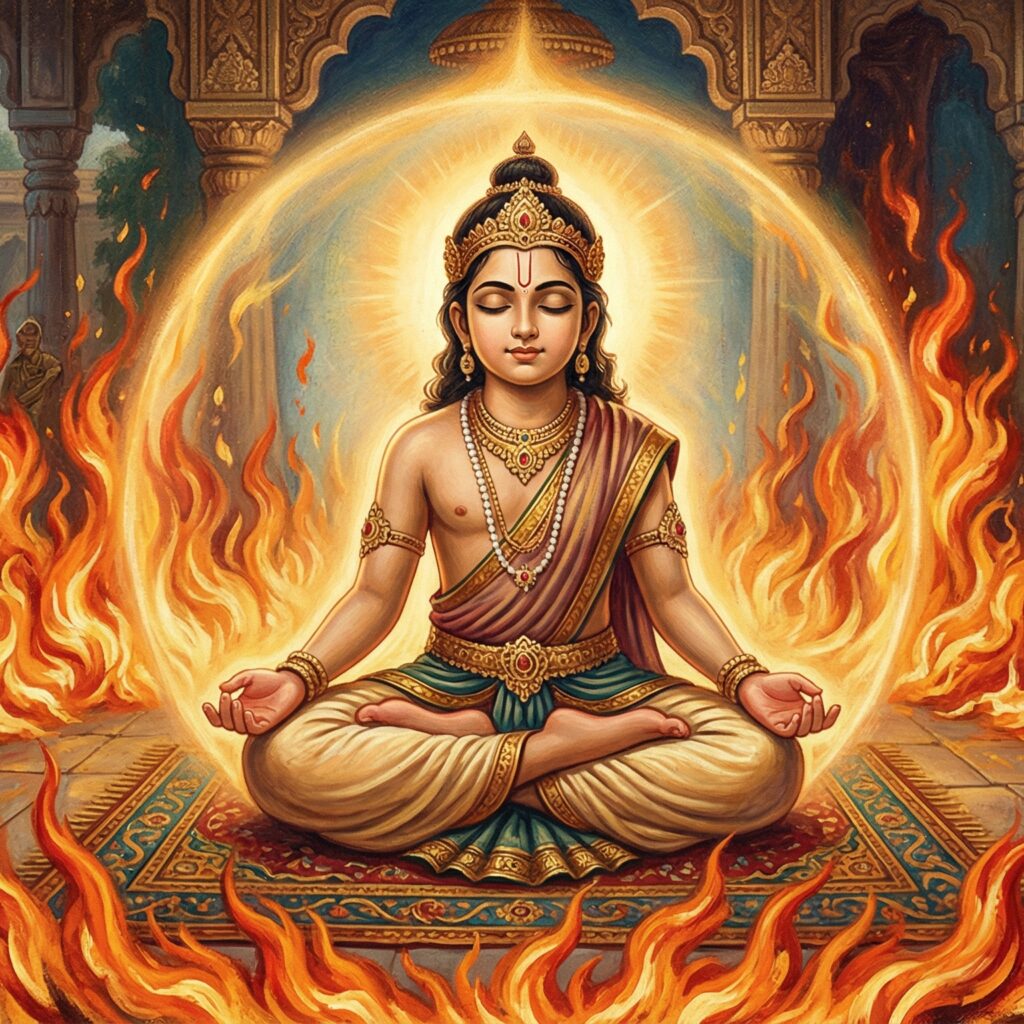
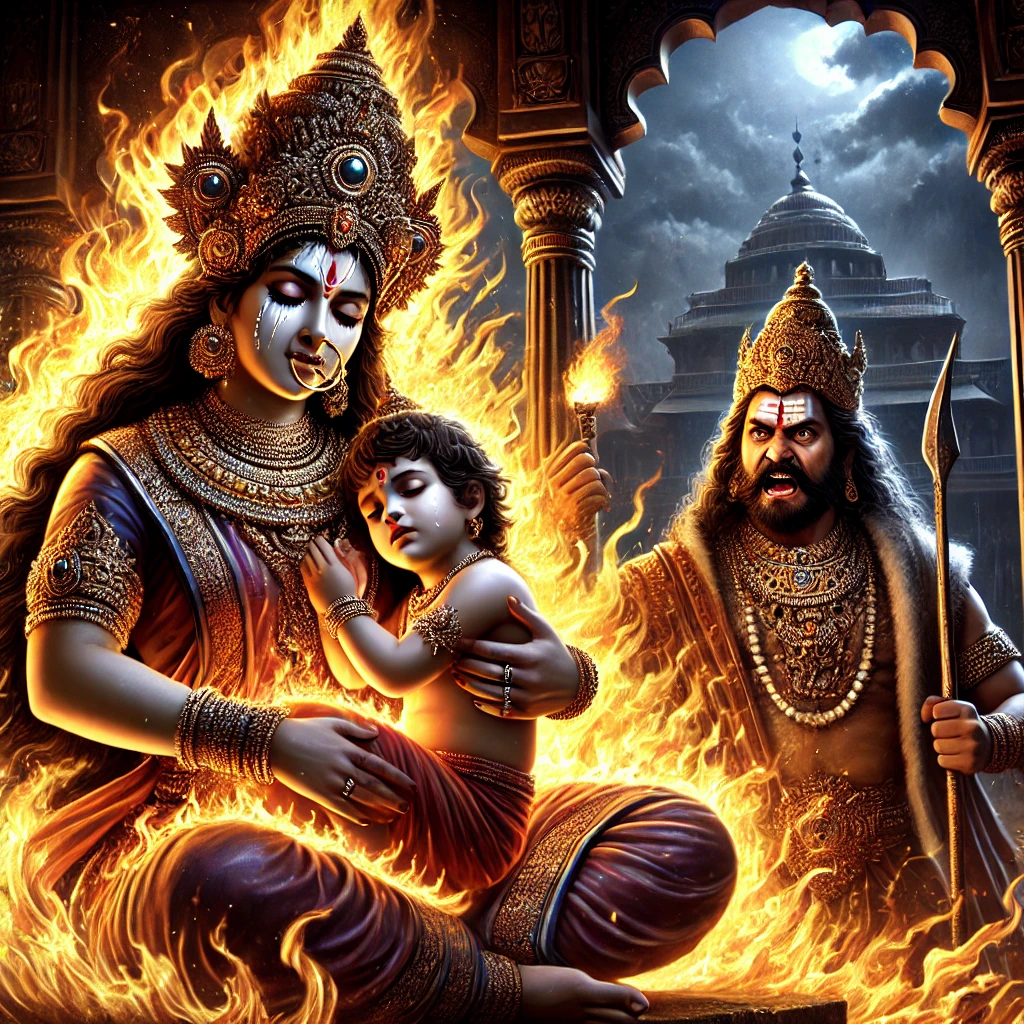
- Holika was Hiranyakashipu’s sister, blessed with a fireproof shawl
- She sat in a great pyre holding Prahlada in her lap
- A divine wind carried the shawl from Holika’s body to Prahlada’s
- Holika burned to ash; Prahlada walked out unscathed, still chanting
- This event gave birth to the festival of Holi, celebrated to this day
The Pillar That Shook the Universe: God Emerges from Stone
Every attempt to kill Prahlada had failed. Now Hiranyakashipu’s rage boiled into something beyond rational thought. He confronted his son directly in the great hall of his palace. The conversation that followed is one of the most celebrated exchanges in all of Hindu scripture.
“Where is this Vishnu of yours?” the demon king demanded, his voice shaking the walls. “Show him to me, and I will believe you.”
“He is everywhere, father,” Prahlada said calmly. “He is in the sky, in the ground beneath your feet, in every creature, in every stone.”
Hiranyakashipu laughed — a terrible, contemptuous laugh. He raised his mighty fist and struck one of the stone pillars of his palace. “Is your Vishnu in THIS pillar?!”
Prahlada replied with complete confidence:
“Yes, he is.”
And then the pillar cracked.
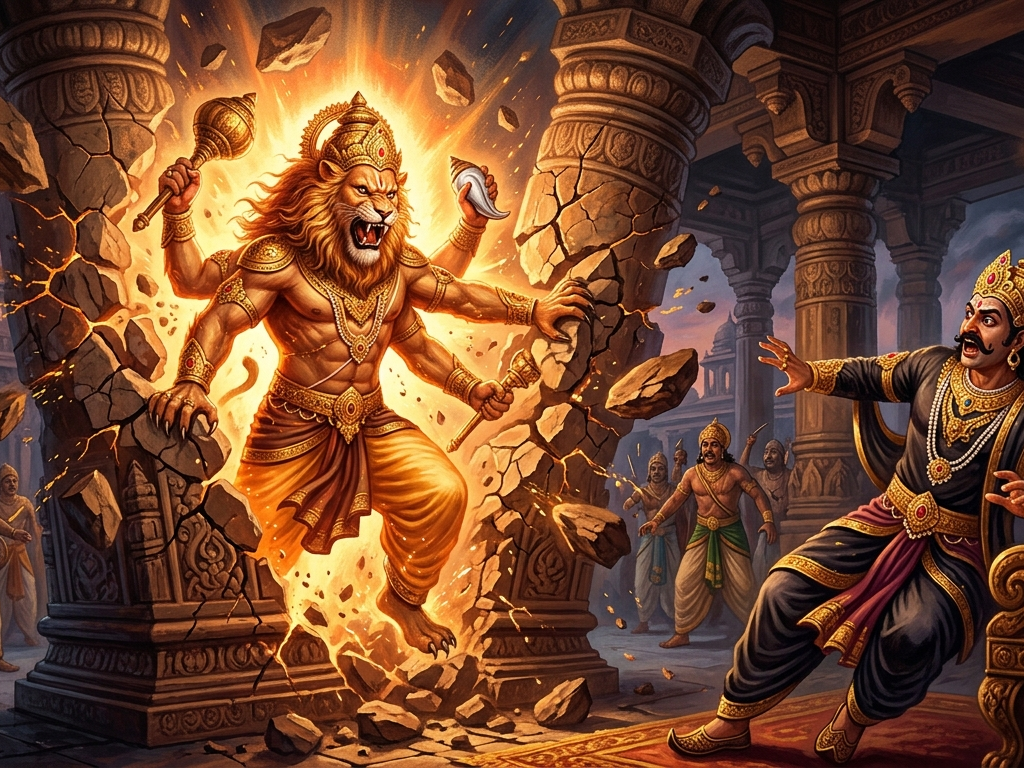
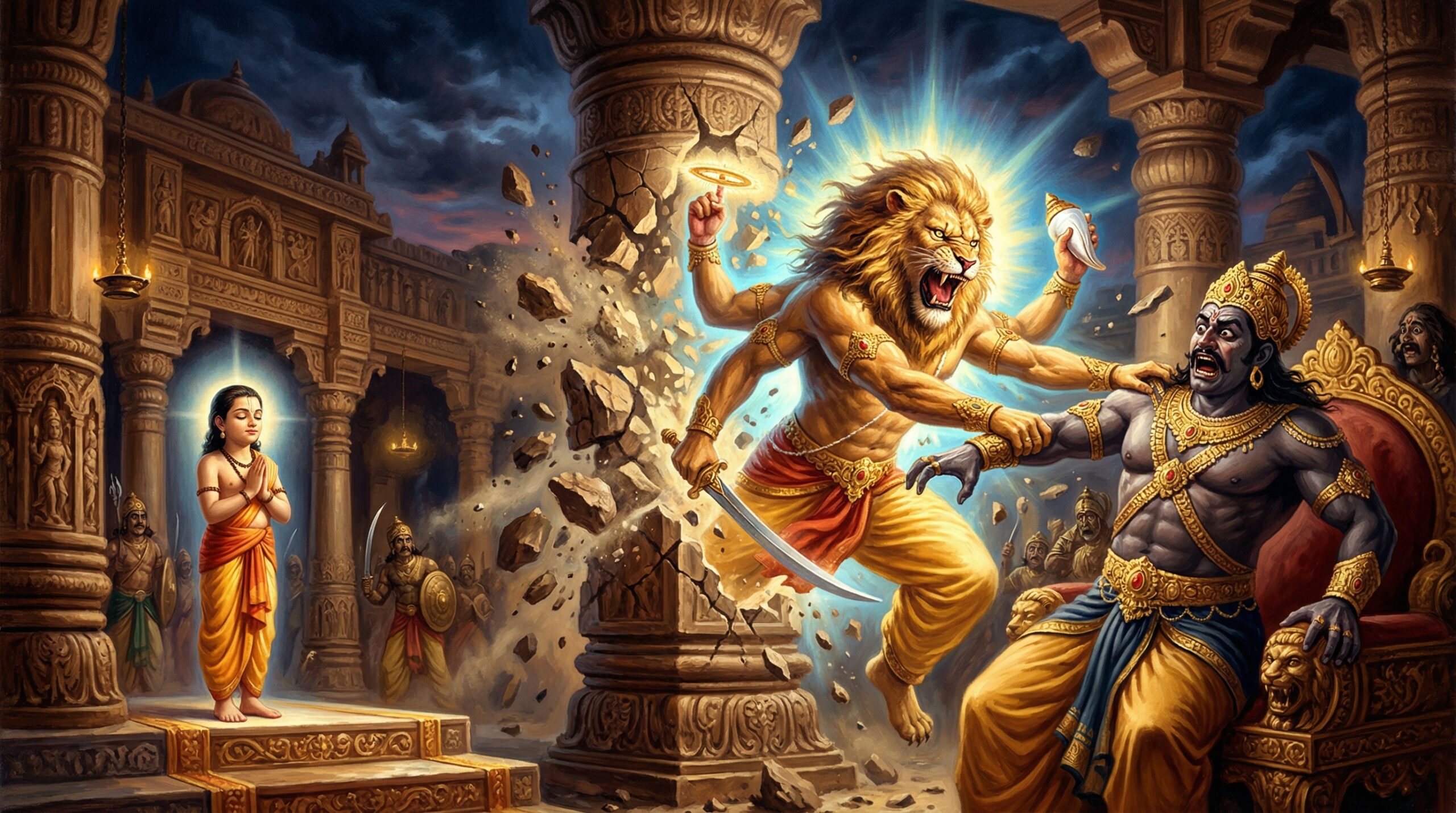
From that cracked pillar erupted a roar that shook the three worlds. Emerging in a blaze of cosmic light was a being of unimaginable power and terrifying beauty: Narasimha — the fourth avatar of Vishnu, neither fully man nor fully lion. His mane blazed like solar fire. His eyes held the fury of all creation’s judgment.
Hiranyakashipu attacked, deploying every demonic weapon at his command. But Narasimha had emerged precisely to fulfill the terms of the boon — to defy every condition the demon had tried to exploit. It was neither day nor night, but dusk. They were neither indoors nor outdoors, but on the threshold of a doorway. The demon was neither on earth, in water, nor in air — he was placed on Narasimha’s lap. And the Lord used neither weapon nor tool — only his fingernails.
“Every condition was fulfilled. Every loophole was sealed. Divine justice is perfect.”
— Interpretation of the Narasimha legend, Bhagavata Purana
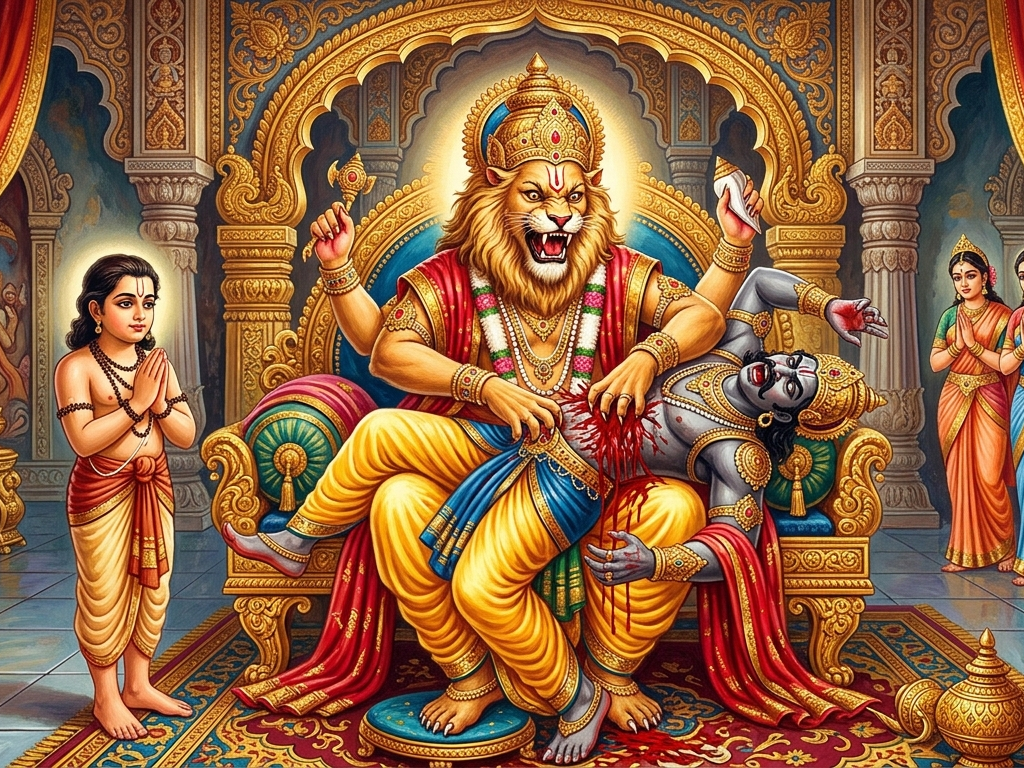
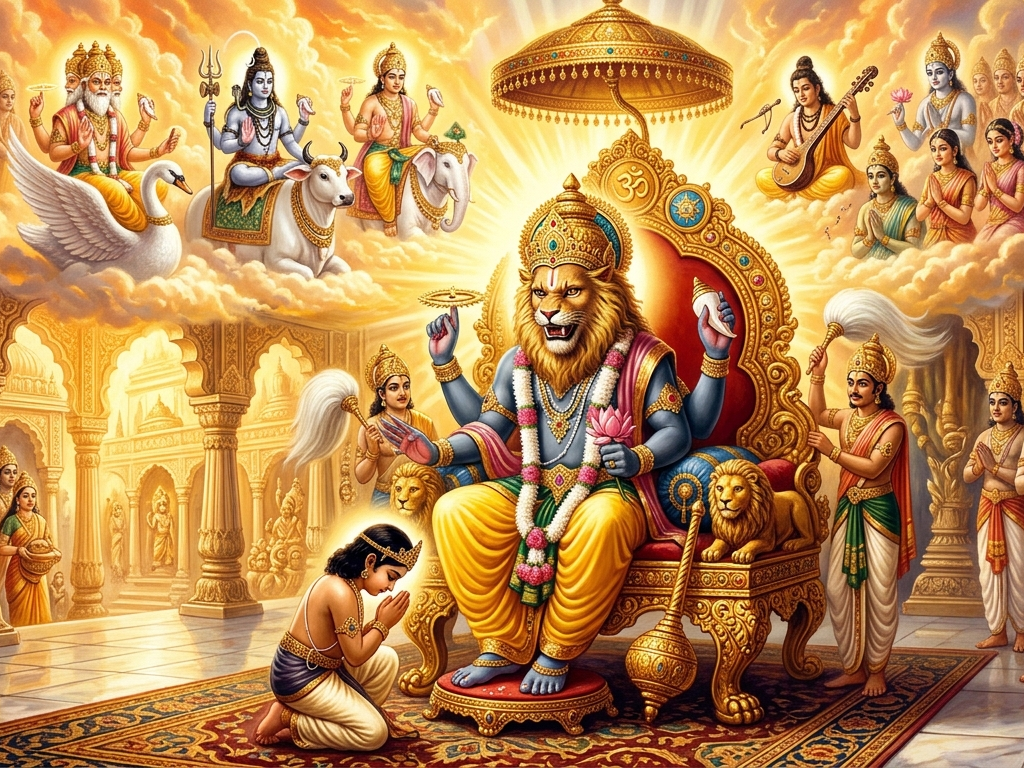
Hiranyakashipu was slain. The universe exhaled. The celestial beings rained flowers from the heavens. And there, in the threshold of that great palace, a small boy walked toward the blazing, fearsome form of Narasimha — and placed his hands on the Lord’s still-trembling chest.
The divine lion’s fury melted into tenderness. He placed his hand on Prahlada’s head in blessing, and the boy wept — not in fear, but in love.
The King Who Ruled with Dharma
After the death of Hiranyakashipu, Narasimha offered Prahlada any boon he desired. This moment is as instructive as all the trials that preceded it. While any other king’s son might have asked for power, wealth, or long life, Prahlada asked for only one thing: that whatever spiritual merit he had accumulated through his devotion be given away to all beings, so that they might be free from suffering.
When pressed further, he asked only that he never forget the Lord, even for a moment — not even in dreams.
Prahlada went on to become a king, ruling his kingdom with wisdom, compassion, and righteousness — traits he had never learned from his father but had absorbed from his devotion. He became one of the legendary Mahajanas — the twelve great souls recognized as exemplary devotees in the Bhagavata Purana, worthy of emulation by all.
🌺Spiritual Meaning of Prahlada’s Story
The legend of Prahlada teaches several timeless lessons:
🪔 Faith is stronger than fear
🪔 Devotion protects the righteous
🪔 Arrogance always leads to downfall
🪔 God is present everywhere
🪔 The divine is omnipresent — in pillars, in oceans, in every beating heart
🪔 The greatest boon is not material — it is unbroken remembrance of the sacred
🪔 Even those born in darkness can become radiant lights of grace
The unwavering devotion of Prahlada reminds us that even a child with pure faith can defeat the greatest evil.
The Eternal Resonance
The legend of Prahlada endures because it speaks to something universal — the experience of being surrounded by forces that would extinguish the light within us, and the extraordinary courage it takes to keep that light burning. His father’s palace was a world of power, fear, and ego. Prahlada lived in that palace but was not of it.
He did not conquer his enemies with a sword. He did not build an army or plot a revolution. He simply loved — absolutely, stubbornly, joyfully — and the universe rearranged itself to protect that love.
In a world that still rewards the powerful and threatens the faithful, in a time when cruelty can occupy thrones and demand to be worshipped, the small figure of a child chanting in a dungeon surrounded by serpents remains perhaps the most radical image in all of world mythology.
He is not a memory. He is a mirror.
✦ ॐ नमो भगवते वासुदेवाय ✦