
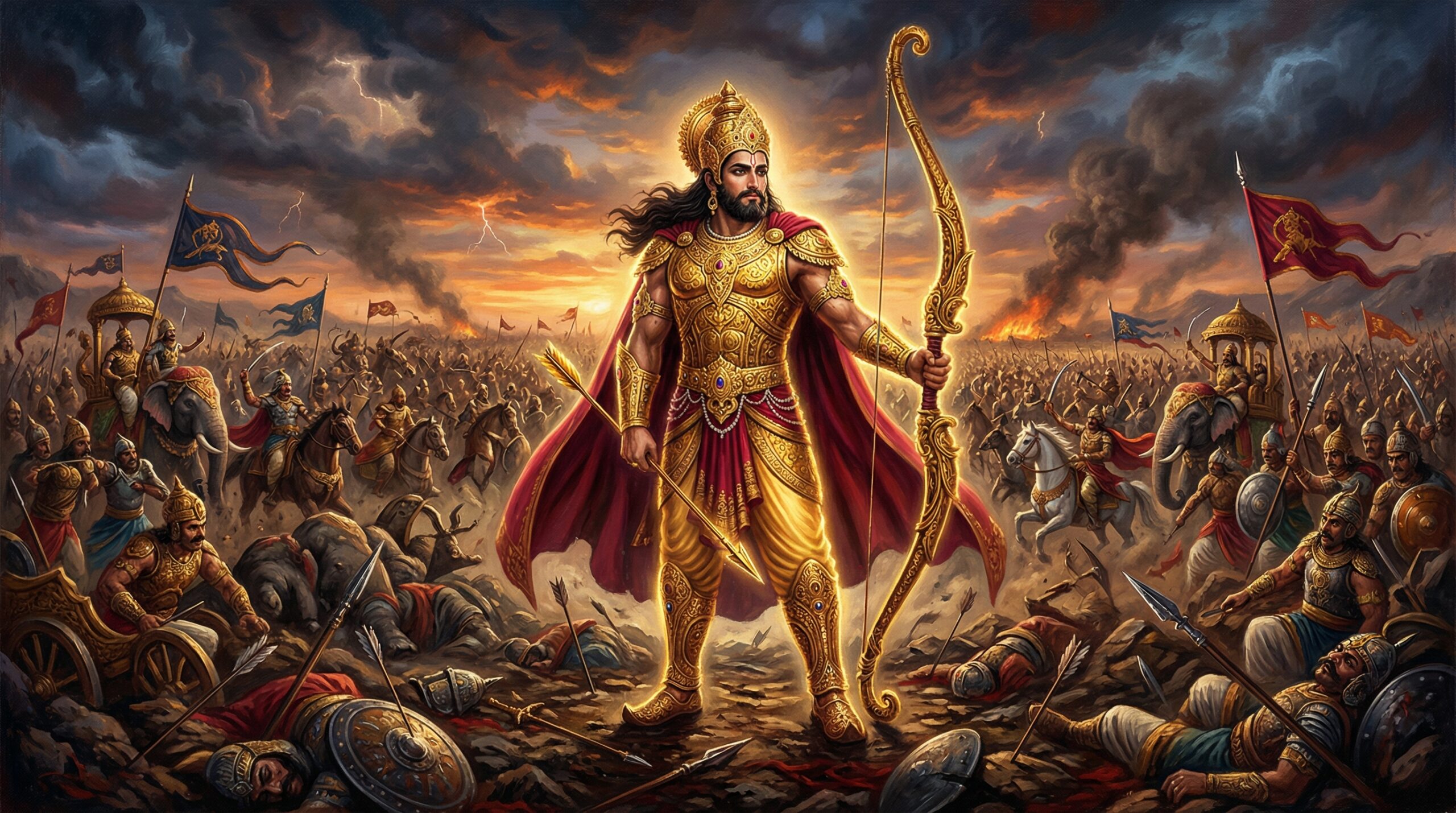
Among all the warriors of the Mahabharata, Karna stands as one of the most powerful yet tragic figures. Born with divine blessings but raised in humble surroundings, his life was shaped by rejection, loyalty, curses, and destiny. The story of Karna is not just about war—it is about honor, sacrifice, and the painful struggle between fate and righteousness.
The Divine Birth of Karna
Before Kunti became the queen of Hastinapur, she was a young princess who received a powerful boon from the sage Durvasa: the ability to summon any god and bear his child. Curious and reckless in her youth, she invoked Surya, the Sun God. A radiant child was born — armoured with a glowing kavach (divine breastplate) fused to his skin and shining kundala (earrings) that marked him as celestial.
But the child was a scandal before he was a blessing. Terrified of social shame and the ruin it would bring her family, Kunti placed the newborn in a wooden box and set him adrift on the Ganga. It was the first — and arguably the greatest — betrayal Karna would ever suffer. He had done nothing wrong. He had simply been born.
The basket drifted until it reached the hands of Adhiratha — a charioteer — and his wife Radha, a childless couple who took the radiant infant as a divine gift. They named him Vasusena, but he would forever be known as Radheya (son of Radha) and later, mockingly, as “Sutaputra” — son of a charioteer. That label would haunt him for his entire life
This moment marked the beginning of Karna’s tragic destiny.

A Warrior Without Recognition
From childhood, Karna possessed extraordinary skills in archery. He dreamed of becoming a great warrior like Arjuna.
Karna’s hunger for martial excellence was insatiable. He sought out Dronacharya — the royal guru of the Kuru princes — but was refused, for Drona only trained royalty and Kshatriyas. Karna, a charioteer’s son, did not qualify. This rejection lit a fire in him that would never be extinguished.
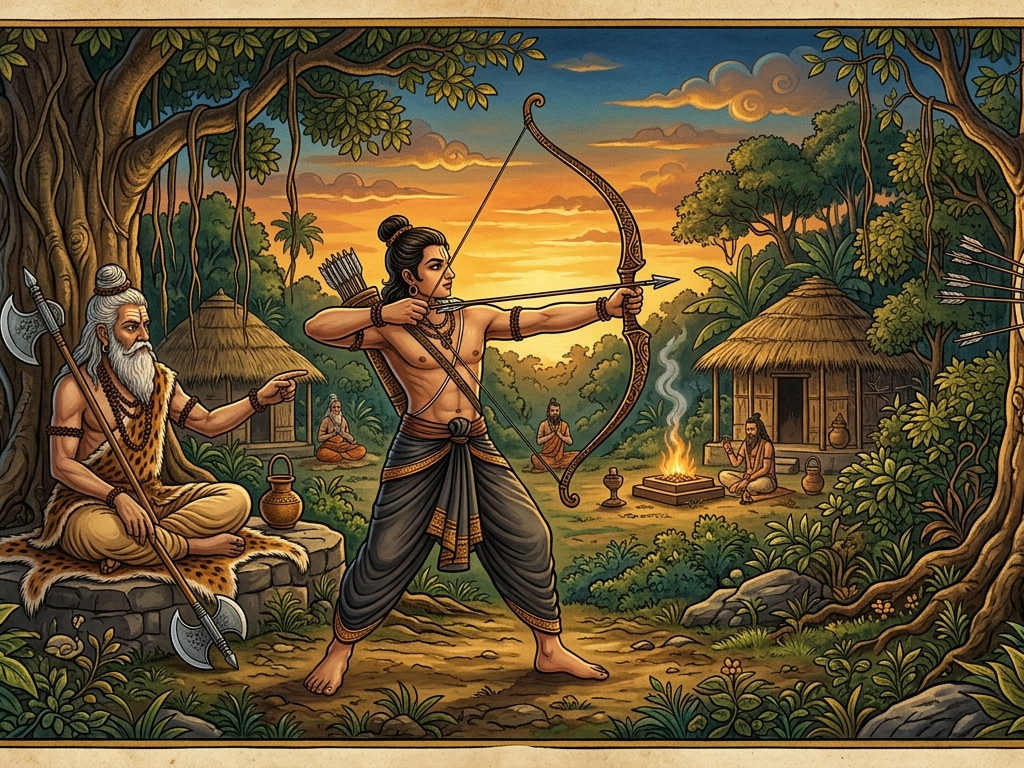
Determined to learn from the greatest, Karna approached the legendary Parashurama — the warrior-brahmin who despised Kshatriyas and trained only brahmins. Karna disguised himself as a brahmin and became Parashurama’s most devoted student. He trained diligently, often until his hands bled, and mastered the Brahmastra — the most powerful weapon in the known world.
“He who is born in a low caste but possesses great virtues surpasses the one born in a high caste who lacks virtue. Character is the measure of a man.”
— Karna’s own words, as preserved in the Mahabharata
The Curse That Sealed His Fate
One day while Parashurama was resting on Karna’s lap, a poisonous insect bit Karna deeply. Blood flowed down his leg, but Karna did not move to avoid disturbing his guru.t, Karna endured the searing pain without a sound.
When Parashurama awoke and saw the wound, he realised only a Kshatriya — trained in the art of bearing pain — could have remained silent. His beloved student had lied about his caste.
Parashurama cursed Karna: when he needed the Brahmastra most — in a moment of mortal danger — he would forget how to invoke it. The curse would destroy him at the hour of his greatest need. It was the second devastating blow dealt to Karna by the hand of fate.
This curse later became one of the key reasons for Karna’s downfall in the great Kurukshetra War
The Friendship That Defined His Life
The turning point arrived at Hastinapur’s grand archery tournament — the Rangabhoomi — where the Kuru princes displayed their skills before the court. Karna arrived and effortlessly matched everything Arjuna had performed. The crowd gasped. Here was a warrior of extraordinary calibre. Then the elders asked his name and lineage.
Kripacharya stepped forward and announced that the competition was for royalty only. A charioteer’s son could not compete with princes. The entire assembly erupted in mockery and laughter. Draupadi reportedly called him a “Sutaputra” and rejected him from the event. Karna stood alone, crown-less, humiliated — his brilliance meaningless without a title.
In Karna’s darkest hour of public humiliation, Duryodhana stepped forward and crowned him king of Anga — a gesture of friendship that bound Karna’s loyalty forever.
It was Duryodhana who stepped out of the royal pavilion and, with the simple act of crowning Karna the king of Anga, silenced every voice of ridicule. “What does birth matter when valour speaks?” Duryodhana declared. From that moment, Karna swore undying loyalty to Duryodhana — not out of ambition, but out of gratitude. The only person who had ever truly seen him, valued him, and stood by him was the man the world called a villain.
This bond — complex, fierce, and unbreakable — would become the centrepiece of Karna’s tragedy. He knew Duryodhana was flawed. He knew the Kauravas were wrong. But he would not abandon the one man who had given him dignity when no one else would.
Karna: The King of Generosity
Karna was born with two miraculous gifts directly from Surya: a kavach — a golden, invincible armour fused into his very skin — and kundala — celestial earrings that radiated divine power. Together, they made Karna near-immortal in battle. No weapon could pierce the kavach; no arrow could truly fell him as long as he wore them. Even the gods trembled at the thought of facing Karna in this state.
Karna was famous for his unmatched generosity. People called him Daanveer Karna, meaning the greatest giver.
Indra, the king of the gods and father of Arjuna, understood this. He knew that if Karna retained his Kovach and kundala, Arjuna could never defeat him. Disguised as a brahmin, Indra appeared before Karna at dawn during his daily worship of the sun. Karna, renowned above all else for his charity — his vow never to refuse any request made at the time of prayer — was asked by the disguised Indra to give away his armor and earrings.
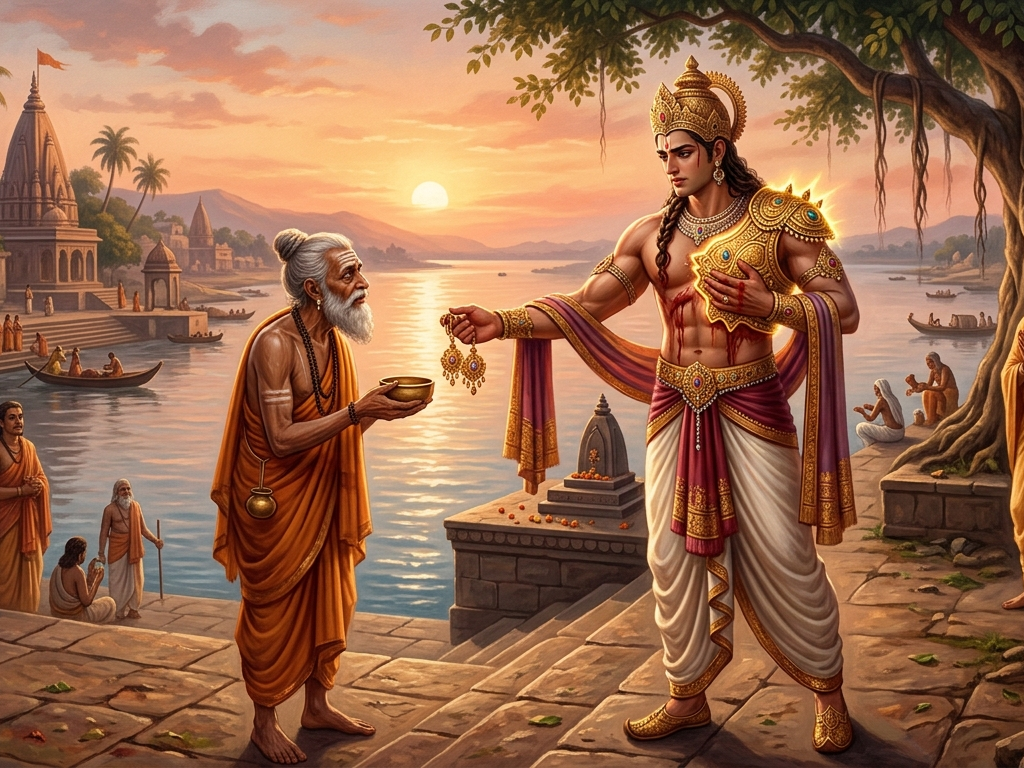
Surya himself appeared to warn Karna — “This brahmin is Indra in disguise. Do not give him what he asks.” Karna smiled and replied that he already knew, but his vow of charity was greater than his desire for life. He cut the kavach from his own skin and removed the kundala from his own ears — offering them to Indra with bloodied hands and a serene expression. Indra, shamed by Karna’s magnanimity, gave him the Vasava Shakti — a divine spear that could kill anyone, even a god — but only once.
It was an act of spectacular self-sacrifice. Karna had knowingly surrendered his immortality. He chose principle over survival — and in doing so, seale.
Knowing that giving them away would make him vulnerable in battle, Karna still offered them without hesitation.
This act of sacrifice made him immortal in legend.
The Character of Karna — Virtues Unmatched
| 🌟 Danavira The greatest donor in the epic — he never refused any request, even at cost of his own life. |
| ⚔️ Peerless Warrior Considered equal to Arjuna — some say superior — in archery, strategy, and battlefield courage. |
| 🤝 Loyal Friend His friendship with Duryodhana was absolute — a bond forged in gratitude that no temptation could break. |
| 🏛️ Righteous King As king of Anga, Karna ruled with justice, generosity, and deep respect for all his subjects. |
| 🕊️ Merciful Spared the lives of four Pandava brothers when he could have killed them, keeping his word to |
| 🙏 Devoted An unwavering devotee of Surya — his daily sunrise prayers were never interrupted, even during war. |
Kurukshetra — Where Destiny Claimed Its Price
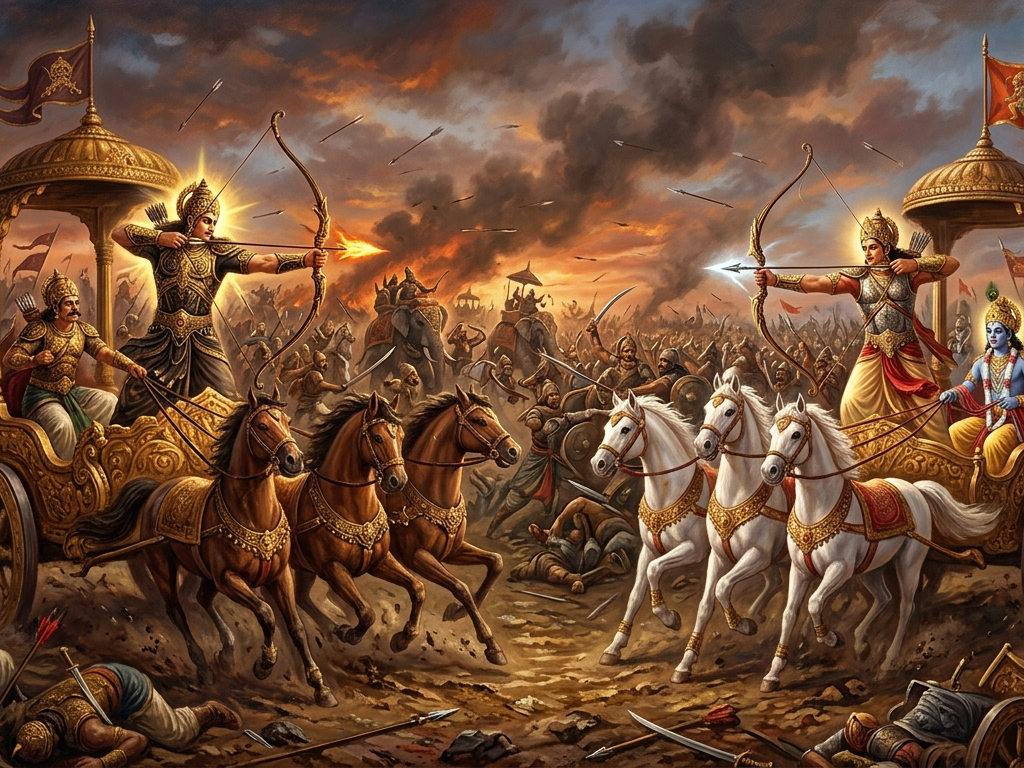
During the Kurukshetra war, Karna finally faced Arjuna in a fierce battle.
At a critical moment, his chariot wheel got stuck in the ground due to another curse. As he struggled to free it, Karna forgot the sacred weapon knowledge because of Parashurama’s curse.
At that moment, guided by Krishna, Arjuna released a powerful arrow that struck Karna down.
Thus ended the life of one of the greatest warriors in history.
Karna’s Final Days in the Kurukshetra War
Day 11
Karna enters the battlefield
Karna replaces Drona as commander of the Kaurava forces. His arrival electrifies the army — his very presence changes the tide of battle. Pandava soldiers tremble.
Day 15
The Vasava Shakti is spent
Karna uses Indra’s divine spear — his one-use weapon that could kill anyone — not on Arjuna, but on Ghatotkacha, whose night-time rampage threatened to destroy the entire Kaurava army. It works, but the spear is gone forever.
Day 17
The final duel
Karna and Arjuna meet in the war’s most anticipated confrontation. The curses begin to activate. Karna’s chariot wheel sinks into the earth — Parashurama’s curse manifesting. He steps down to free it, unarmed and defenceless.
Day 17 — Dusk
The fall of the sun’s son
At Krishna’s urging, Arjuna releases his arrow while Karna is unarmed and lifting his wheel. It was not a fair death — and every witness knew it. Karna fell without protest, meeting fate with open eyes.
The Truth Revealed After His Death
After Karna’s death, Kunti revealed the heartbreaking truth that he was her eldest son and the brother of the Pandavas.
The Pandavas were filled with grief and regret.
Karna had lived his entire life seeking respect and identity, but the truth about his birth came only after his death.
The Injustices That Defined His Life
To understand Karna’s tragedy is to catalogue the injustices heaped upon him by birth, society, and the cosmos itself — and to marvel at how he rose above them without bitterness.
What Karna suffered — and never deserved
- Abandoned by his mother Kunti immediately after birth, for no fault of his own — cast away to protect social reputation.
- Denied education by Dronacharya solely because of caste — his skill was irrelevant; his birth was unacceptable.
- Publicly humiliated at the Rangabhoomi tournament by the same princes who could not match his skill.
- Cursed by Parashurama for a deception born of desperation — the system had left him no honest path to learning.
- Manipulated by Indra into surrendering his divine armour — exploited for his own virtue against him.
- Rejected by Draupadi at her swayamvara for being a “sutaputra” — his caste again used as a weapon.
- Killed while unarmed and defenceless — his death engineered through divine manipulation, not honest combat.
- His true identity revealed to the world only after his death — never honoured as Pandava while alive.
After Death — A Test Even in the Afterlife
The Mahabharata contains a remarkable episode after Karna’s death. When his soul reached the afterlife, he was offered gold and jewels as food. Bewildered, he asked why. The answer came: throughout his life, he had given away so much gold that gold was what he possessed in abundance. But he had never thought to offer food in Shraddha (memorial rites) for his ancestors.
Karna, with characteristic dignity, accepted the judgment and then requested — and received — fifteen days on earth to correct this omission. He returned and performed the Shraddha with full devotion, offering food and water to his ancestors. It was his final act of dharma, completed even after death. He returned to the heavens and was honoured as Danavira Karna — the greatest giver.
Krishna himself, after the war, declared that Karna’s generosity was unparalleled — that in a direct comparison of dharma, even Yudhishthira could not match Karna’s sacrifice. Coming from Krishna, the architect of Karna’s defeat, this was an extraordinary vindication.
Why Karna Is Called the Greatest Tragic Hero
The story of Karna is powerful because it reflects the struggles of human life:
- A hero born with divine power but denied recognition
- A warrior cursed despite his dedication
- A man who chose loyalty over personal gain
- A generous soul who gave away everything—even his own protection
Karna’s life reminds us that true greatness lies not in victory, but in character, sacrifice, and honor.
Conclusion
In the vast ocean of the Mahabharata — the longest epic ever written — one figure rises above all others in the sheer force of his tragedy: Karna. Neither villain nor flawless hero, he was a man forged by rejection and elevated by virtue, cursed by fate and yet graced by the sun itself. His story is not merely a tale of war and rivalry; it is a meditation on identity, loyalty, dharma, and the cruel indifference of destiny.
Known by many names — Vasusena, Radheya, Angraj, Surya-Putra — Karna remains, thousands of years after the Mahabharata was composed, the most beloved and most tragic figure in Indian mythology. To know Karna is to understand what it truly means to be human: to strive with honour in a world that offers none in return.
Karna did not live the life he deserved. He was denied education, identity, love, and finally — a fair death. Yet at every turn, he chose grace over bitterness, loyalty over self-interest, and charity over survival. In a world that was consistently unjust, he was consistently noble. That is his tragedy. That is also his immortality.
— “Surya-Putra. Radheya. Angraj. Danavira. Karna.” —
The Mahabharata asks a question it never fully answers: was Karna’s defeat the triumph of dharma, or its greatest failure? The text leaves this open — deliberately, as all great art does — because the answer depends on what kind of person you are and what kind of world you believe in.